
Uncategorized
Boutonnieres & Corsages: A Modern Etiquette Guide
Nov
A boutonniere is one of the smallest arrangements a florist builds, yet it carries more etiquette weight per square inch than almost anything else in the wedding or prom order. Measuring roughly 3 to 4 inches from stem wrap to bloom tip, a single boutonniere can signal the wearer’s role in a ceremony, coordinate with a wedding party’s color palette, or mark a prom date’s corsage in deliberate, matching detail. This guide walks through the technical construction of a boutonniere, how it differs from a wrist corsage, who traditionally wears one, current pricing and material standards, and the practical etiquette questions that come up most often when ordering groom flowers, a lapel flower for a father of the bride, or a prom corsage pairing for a formal dance.
What Is a Boutonniere and Why Does It Matter in Wedding Attire?
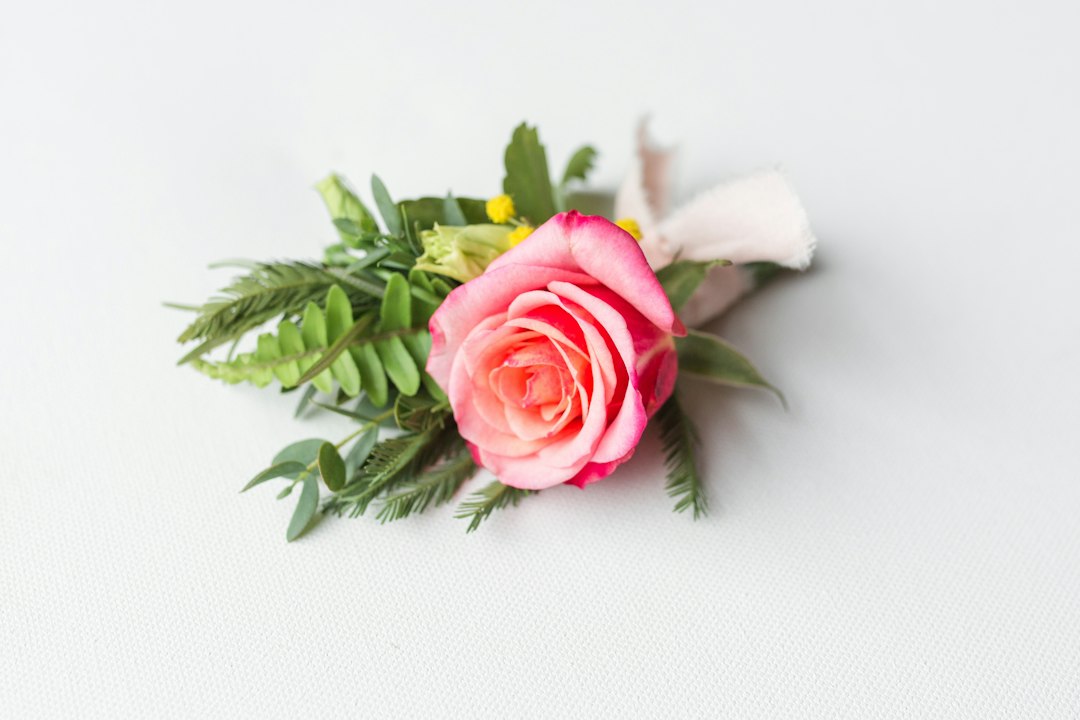
A boutonniere is a single flower or small cluster of flowers, typically 1 to 3 stems, pinned or magnetically attached to the left lapel of a suit jacket, worn traditionally by men in a wedding party, at prom, or at formal events. The term comes from the French “boutonnière,” meaning buttonhole, referencing the era when a jacket’s lapel actually had a small loop sewn in to hold a single bloom stem without a pin. In modern floristry, the boutonniere functions as the male counterpart to the bridal bouquet, echoing its color story in miniature.
The reason a boutonniere matters goes beyond decoration. At a wedding, it visually distinguishes the groom from groomsmen, often through size (a groom’s boutonniere runs slightly larger, around 3.5 inches, versus 2.5 to 3 inches for groomsmen) or through an accent bloom not used elsewhere. Fathers, grandfathers, and ushers typically receive a simpler, single-bloom version, which keeps the visual hierarchy of the wedding party clear to guests and photographers alike.
How Did the Boutonniere Tradition Originate?
The boutonniere traces back to medieval Europe, when knights reportedly wore a lady’s colors into battle or tournament as a token of favor, a custom that evolved into gentlemen wearing a flower matching a courted woman’s bouquet. By the Victorian era, floriography (the language of flowers) was at its height, and a gentleman’s buttonhole flower often carried a coded sentiment, a rosebud for a new courtship or ivy for fidelity, for instance.
By the early 20th century, the boutonniere had become a standard component of formal menswear rather than a romantic signal, worn at weddings, funerals, and black-tie events regardless of courtship status. Today’s version keeps that formal association but has loosened considerably in material choice, with succulents, berries, and even dried wheat appearing alongside classic rose and carnation varieties.
How Does a Boutonniere Differ from a Wrist Corsage or Prom Corsage?
A boutonniere is worn on the lapel by men, while a corsage is worn by women, either pinned to clothing or, more commonly today, secured to the wrist with an elastic or ribbon band, hence the term wrist corsage. The construction differs technically too: a boutonniere uses minimal foliage and a tight, compact wire-and-tape stem, while a corsage typically includes a small cluster of 2 to 4 blooms, filler such as waxflower, and sometimes a satin ribbon bow that a boutonniere never carries.
At prom specifically, the prom corsage and matching boutonniere are usually ordered as a pair, timed for pickup within 24 to 48 hours of the event since most fresh-flower versions only hold up for about 8 to 12 hours of wear before petals start to bruise or wilt under gymnasium or ballroom lighting. Many prom florists now offer a wristlet-style corsage with a adjustable band in sizes from 2 to 3 inches in diameter, designed to survive dancing without the pin punctures that plagued older pin-on styles.
What Materials Distinguish a Lapel Flower from a Corsage?
A lapel flower, the more formal term for a boutonniere, is built on a thin 20- or 22-gauge floral wire, wrapped in floral tape in a shade matching the bloom (typically green or brown), and finished with a corsage pin roughly 2.5 inches long. The bloom itself is almost always trimmed to a single flower head or a tight cluster no wider than 2 inches, since anything bulkier looks disproportionate on a jacket lapel and tends to droop by the end of a reception.
A corsage, by contrast, uses a sturdier wire gauge (18-gauge is common for the base structure) because it must support the weight of multiple blooms plus ribbon without sagging on the wrist. Corsage construction also frequently incorporates a plastic or metal wristlet band, something a boutonniere never requires, since its only anchor point is the pin through fabric.
| Feature | Boutonniere | Wrist Corsage |
|---|---|---|
| Typical wearer | Groom, groomsmen, fathers, ushers, prom date (male) | Bridesmaids, mothers, prom date (female) |
| Attachment point | Left lapel, via pin or magnet | Wrist, via elastic or ribbon band |
| Average size | 2.5 to 3.5 inches | 3 to 5 inches in diameter |
| Wire gauge used | 20 to 22 gauge | 18 gauge base wire |
| Typical stem count | 1 to 3 stems | 2 to 4 blooms plus filler |
| Average vase/wear life | 8 to 12 hours unrefrigerated | 8 to 10 hours unrefrigerated |
| Average price (fresh flower) | $12 to $25 | $20 to $40 |
Shop Our Signature Collection
Hand-crafted luxury bouquets from our Rodeo Drive atelier, with same-day delivery across Beverly Hills, Bel Air & Los Angeles.
What Flowers Work Best for a Boutonniere and How Should They Be Chosen?
Spray roses, miniature carnations, and ranunculus are the most durable boutonniere choices because their petal structure holds up under handling and limited water access for 10 to 12 hours, making them reliable for a full wedding day from morning photos through a late reception. A single garden rose bud, trimmed to roughly 1.5 inches across, remains the most requested option for a groom’s boutonniere because it reads as formal without excessive size.
Choosing the right bloom also depends on seasonal availability and the broader floral design of the wedding. A winter wedding boutonniere built around a sprig of eucalyptus and a dried rose holds up better in cold outdoor air than a delicate stephanotis bloom, which bruises below 50°F. Grooms increasingly request succulents (Echeveria varieties around 1 to 1.5 inches wide) for a textural, long-lasting alternative that can even be kept as a keepsake after the wedding since succulents can be replanted.
Which Flower Varieties Are Most Common in a Groom’s Boutonniere?
The most common varieties are garden roses, spray roses, ranunculus, calla lily (mini varieties around 3 inches long), and lily of the valley, each chosen for a mix of durability and formality appropriate to groom flowers. Many florists also incorporate a single stem of astilbe or a sprig of rosemary for fragrance and texture, especially in late spring and summer ceremonies when herbal accents are on trend.
For couples wanting their boutonniere and bridal bouquet to visually relate without being identical, florists often repeat one accent bloom, for instance, if the bouquet uses Roses as its anchor flower, the groom’s boutonniere might use a single spray rose in the same cultivar, scaled down. This approach reads as coordinated rather than matchy, which most modern couples prefer over identical mini-bouquets pinned to a lapel.
- Garden roses and spray roses – classic, hold up 10+ hours unrefrigerated
- Ranunculus – layered petals, lasts 8 to 10 hours once cut and wired
- Mini calla lily – sleek, modern silhouette, roughly 3 inches long
- Succulents (Echeveria) – no water needed, can be preserved as a keepsake
- Astilbe or rosemary sprigs – textural and fragrant accent, low cost per stem
- Lily of the valley – delicate and fragrant, best for cooler indoor venues
Couples drawn to romantic, old-world symbolism sometimes request a boutonniere built around a peony bud rather than a rose, particularly for late-spring weddings when peonies are in peak season; this pairs naturally with a bouquet discussed in our guide to peony symbolism in weddings. Orchid-based boutonnieres, using a single Cymbidium bloom roughly 3 inches wide, are another durable option for tropical or destination weddings, holding up for a full 12-hour day without refrigeration.
Who Should Wear a Boutonniere and What Are the Modern Etiquette Rules?
Traditional etiquette calls for the groom, groomsmen, ushers, officiant, fathers of the bride and groom, and grandfathers to wear a boutonniere, while ring bearers typically receive a smaller, simplified version scaled to about 2 inches for comfort on a child’s jacket. Modern weddings have relaxed these rules considerably, with same-sex couples, non-binary wedding party members, and even female guests in suits now commonly requesting a boutonniere rather than a corsage, based purely on personal preference rather than gender convention.
At prom, etiquette dictates that the date who purchases the flowers typically buys a prom corsage for their date and may also provide a matching boutonniere if asked, though many schools now encourage couples to simply coordinate colors independently rather than follow rigid purchasing rules. A corsage and boutonniere pairing in matching ribbon, for example burgundy satin on both, remains the most requested prom combination according to seasonal order patterns most florists see each spring.
Does the Mother of the Bride Wear a Boutonniere or a Corsage?
The mother of the bride traditionally wears a corsage, not a boutonniere, usually pinned near the shoulder or worn as a wristlet to avoid damaging delicate fabric with a pin. This distinction has held steady even as other gendered boutonniere rules have loosened, since a pinned corsage on a mother’s dress remains a widely recognized visual marker of her role during the ceremony and in family photographs.
Some modern brides request a smaller version of the bridal bouquet’s accent flower, such as a 2-inch spray of Hydrangea petals bound into a compact corsage, to visually tie mothers and grandmothers into the overall color scheme without the formality of a full corsage cluster. Fathers and grandfathers in the same family, by contrast, would still receive the matching boutonniere rather than a corsage, preserving the traditional gender line even within updated designs.
How Much Does a Boutonniere Cost and How Should Couples Budget for It?
A standard fresh-flower boutonniere costs between $12 and $25 per piece depending on the flower variety, with premium blooms like garden roses or orchids pushing costs toward $25 to $35 each. For a wedding party of six groomsmen plus a groom, father, and two grandfathers, that typically totals $120 to $280 just for boutonnieres, a line item couples often underestimate when building a full floral budget.
Prom pricing runs slightly lower per piece, averaging $15 to $20 for a boutonniere, since prom florals generally use simpler single-stem designs rather than the layered construction seen in wedding versions. Couples and prom-goers can reduce cost by choosing in-season blooms, for instance ranunculus in spring runs cheaper than imported orchids in winter, and by ordering boutonnieres in the same bulk order as the bridal party’s bouquets to qualify for package discounts many florists offer at 10 or more stems.
What Factors Cause Boutonniere Prices to Vary Between Florists?
Price variation comes down to four factors: flower variety and import cost, labor time (a wired, taped boutonniere takes a skilled florist roughly 8 to 12 minutes to construct), add-ons like preservation spray or a custom ribbon wrap, and rush-order fees for requests placed within 72 hours of an event. A destination wedding requiring refrigerated shipping of a boutonniere order can add $50 to $100 in delivery costs alone, separate from the per-piece flower price.
Couples planning a full wedding floral order, including a Wrap Bouquet for the bride and coordinating boutonnieres for the party, typically save 10 to 15% by bundling every arrangement through a single florist order rather than sourcing boutonnieres separately from the bridal bouquet. This also ensures color and variety consistency, since dye lots and bloom sizing can vary slightly between different flower suppliers.
My Experience with Boutonniere Design at Muguet Florist
Over the past several wedding seasons working boutonniere orders at our Beverly Hills studio, I have found that the single biggest point of confusion for couples is sizing: grooms frequently request a boutonniere as large as the bride’s bouquet focal flower, not realizing that anything wider than about 2.5 inches starts pulling at a lapel buttonhole and looks heavy in photographs by hour three of a reception. I now routinely recommend a test pin on the actual suit jacket during the final consultation, two weeks out, rather than relying on a photo reference alone.
I have also noticed a clear shift in requests over the last three years toward succulent and dried-material boutonnieres, particularly for fall and winter ceremonies, since clients want a keepsake that survives beyond the wedding day itself. One groom in late 2023 asked us to build his boutonniere entirely from preserved eucalyptus and a single dried protea, roughly 2 inches across, specifically so it could sit in a shadow box afterward rather than wilt in a drawer. For prom orders, the recurring issue is timing: corsages and boutonnieres built more than 24 hours ahead of an evening dance noticeably lose petal firmness, so I always advise same-day or next-day pickup rather than ordering a week in advance, even though many students try to do exactly that to avoid last-minute stress.
Order from Muguet Florist, Beverly Hills
Shop These Arrangements
Our Floral Services
Same-Day Delivery Areas
Send Flowers Today
Order by our same-day cutoff for hand-delivered arrangements across Beverly Hills, Bel Air, Hollywood & Los Angeles.
FAQ
Can a boutonniere be made without fresh flowers?
Yes, boutonnieres are commonly made from silk flowers, dried botanicals, or succulents, all of which avoid refrigeration needs and can be assembled days or even weeks in advance, unlike fresh-flower versions that must be built within 24 to 48 hours of the event.
How far in advance should a boutonniere be ordered for a wedding?
Most florists recommend finalizing a boutonniere order 6 to 8 weeks before the wedding date, with the actual flowers cut, wired, and assembled 1 to 2 days before the ceremony to maximize freshness through the full event.
Should the groom’s boutonniere match the bridesmaids’ flowers or the bride’s bouquet?
The groom’s boutonniere traditionally echoes the bride’s bouquet rather than the bridesmaids’ arrangements, often repeating the same focal flower variety at a smaller scale, roughly one-tenth the size of the full bouquet, to visually link the couple without matching the wedding party.
How is a boutonniere attached correctly to a lapel?
A boutonniere is pinned through the lapel’s buttonhole or fabric at a slight diagonal angle using a corsage pin roughly 2.5 inches long, inserted from behind the lapel so the pinhead sits hidden against the jacket rather than visible from the front.
Can a boutonniere be reused or preserved after the event?
Fresh-flower boutonnieres generally cannot be reused due to wilting within 12 to 24 hours, but varieties like succulents, dried protea, or preserved eucalyptus can be kept intact for months and are increasingly chosen specifically for that reason.
For couples exploring broader floral symbolism before finalizing a boutonniere design, our complete guide to flower meanings covers how individual bloom choices can carry sentiment throughout a wedding’s overall design, from the bridal bouquet down to the smallest lapel flower. Those planning an anniversary celebration afterward may also find our Anniversary arrangements a natural next step for commemorating the date each year.
Sources
University of Minnesota Extension: Growing Roses
